Creating Graphs
Create graphs to visualize your data. This page explains basic graph types including histograms, scatter plots, bar charts, and time series plots.
How to Create Graphs
- Open Graph Builder tab: Select Analysis → Graph Builder... from the menu bar
- Select dataset: Choose the dataset to graph from the dropdown menu in the header
- Select graph type: Click the type of graph you want to display (Histogram, Scatter Plot, Bar Chart, etc.)
- Configure settings: Set axes and variables according to the selected graph type
- Histogram: Variable, number of bins, grouping
- Scatter plot: X-axis, Y-axis, color coding
- Bar chart: Category, value, aggregation method, sorting
- Adjust options: Set filter conditions and additional options as needed
Graphs are displayed in real-time in the preview area on the right, allowing you to explore optimal visualizations while changing settings.
Basic Graphs
Histogram
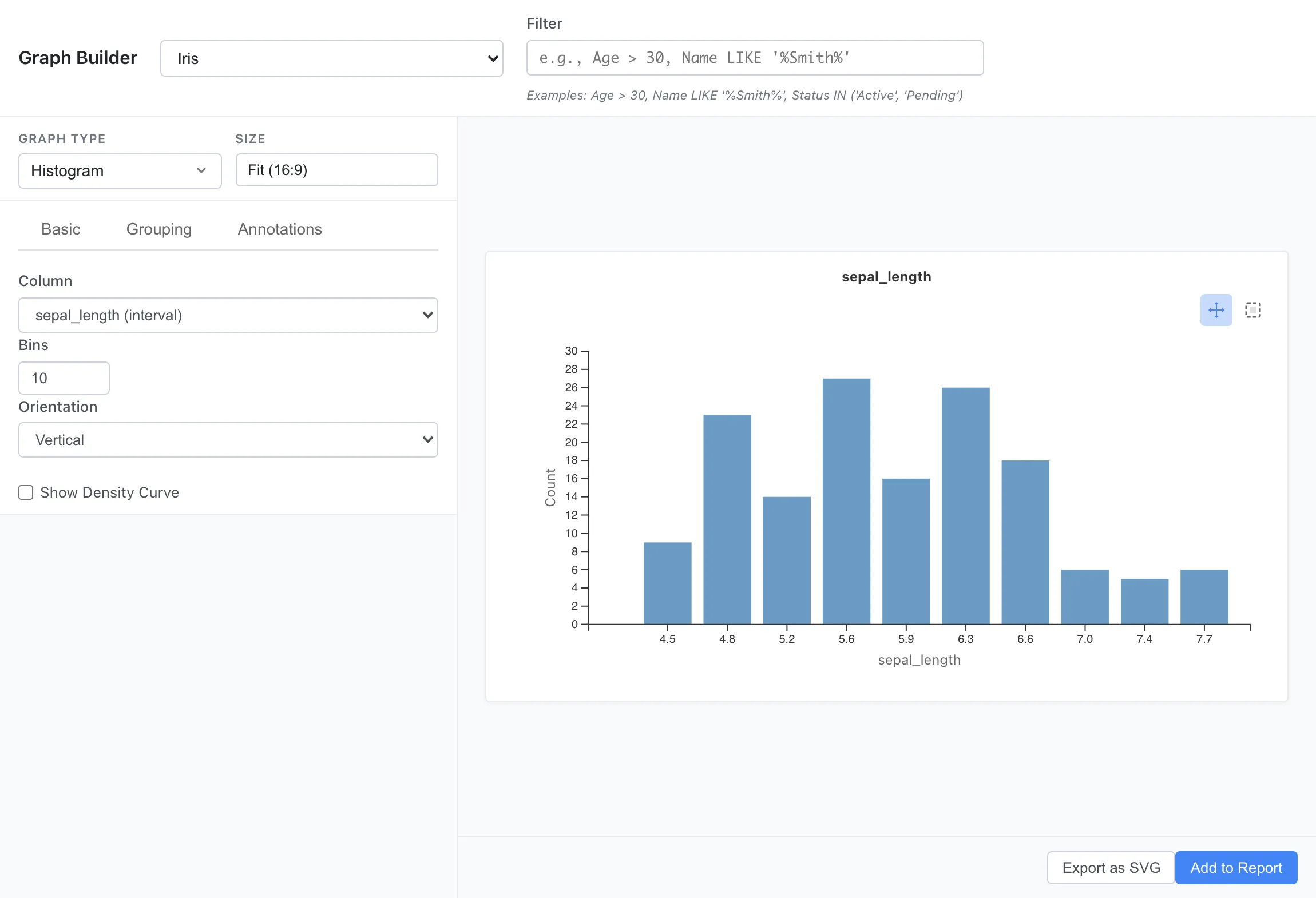
Displays the distribution of a single numeric variable as a bar graph. Useful for understanding frequency distribution and shape of data, and identifying outliers.
Use cases:
- Check age distribution
- Examine test score distribution
- Understand sales amount distribution
Settings:
Basic tab:
- Column: Select the numeric column to graph
- Bins: Specify the number of bars (bins)
- Orientation: Vertical or horizontal bars
- Show Density Curve: Overlay a density curve on the histogram
Grouping tab:
- Group By: Select a category column to display color-coded by group
Annotations tab:
- Show Mean: Display the mean as a solid line
- Show Median: Display the median as a dashed line
Scatter Plot
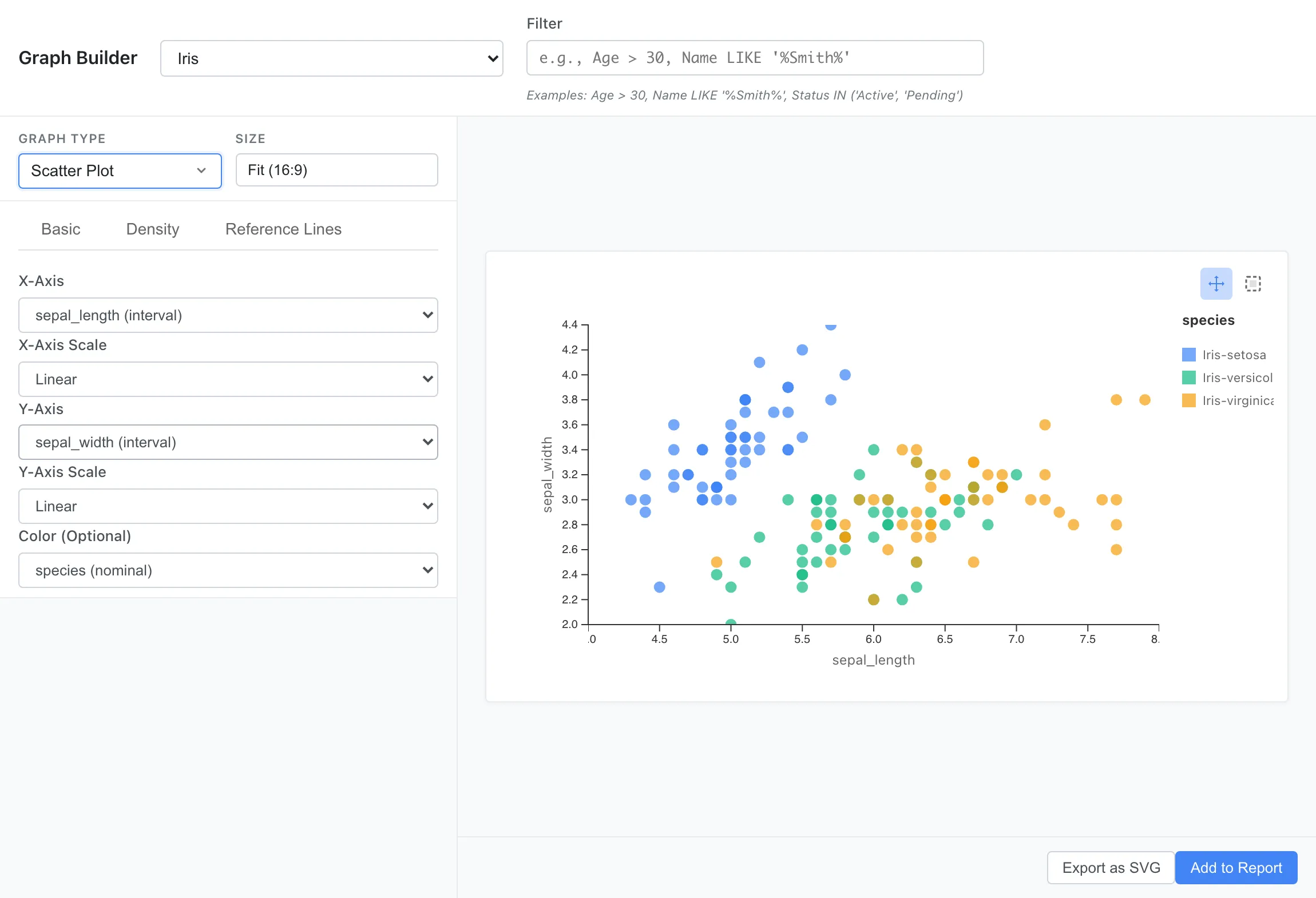
Visualizes the relationship between two numeric variables as points. Discover correlations, patterns, clusters, and outliers. Also supports density visualization and grouping by categorical variables.
Use cases:
- Examine relationship between height and weight
- Check correlation between advertising spend and sales
- View relationship between scores in two exam subjects
Settings:
Basic tab:
- X-Axis: Numeric column for horizontal axis
- Y-Axis: Numeric column for vertical axis
- Color: Select a category column for color-coded grouping
Density tab:
- Display Mode: Select display mode
- Points only: Show points only (for small datasets)
- Density only: Show density only
- Points + Density (Outliers Only): Show density with outlier points
- Points + Density (All Points): Show density with all points
Reference Lines tab:
- Add Reference Line: Adds reference lines to mark specific values or thresholds
Bar Chart
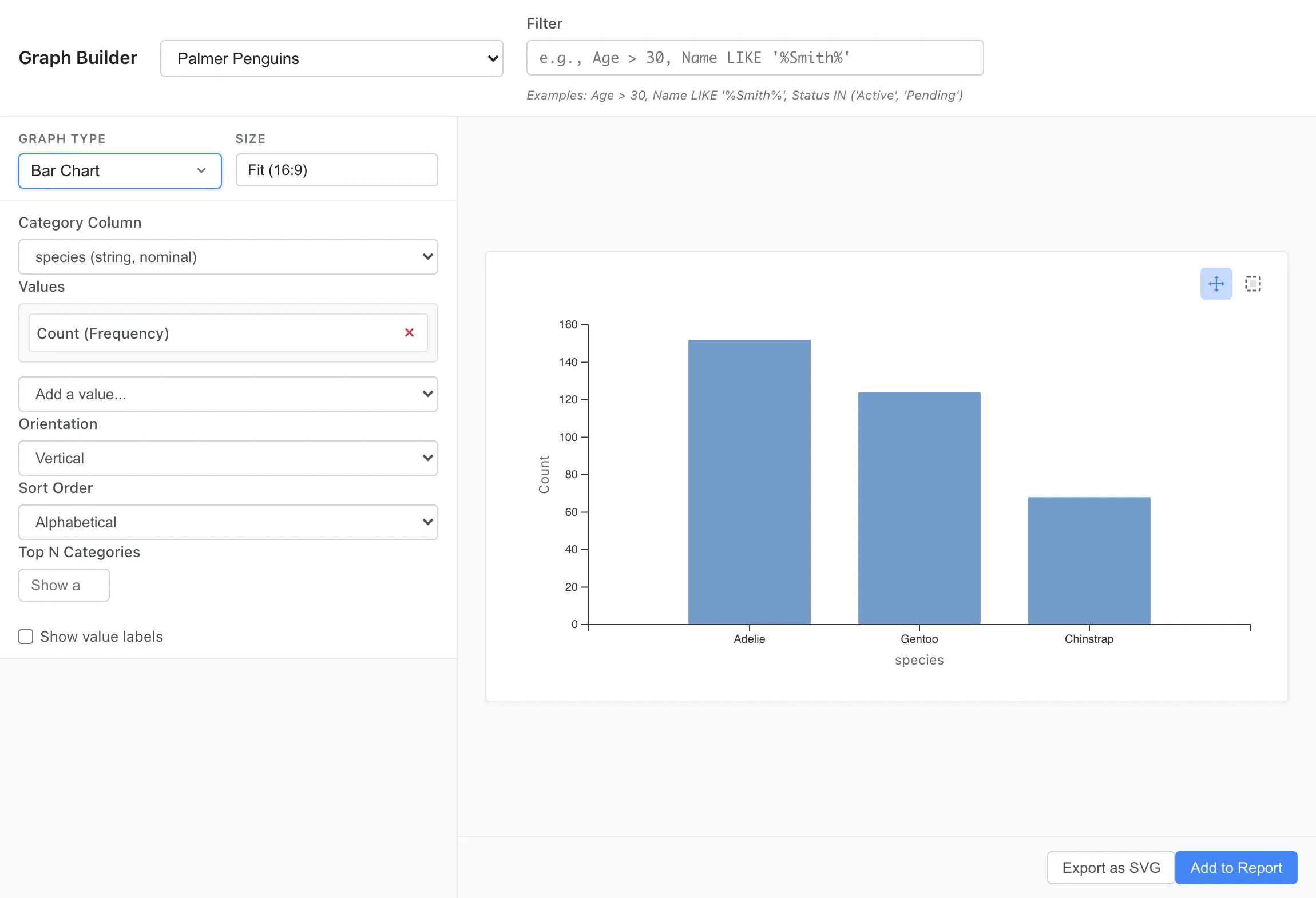
Compares values by category using vertical or horizontal bars. Ideal for comparing categorical data, ranking displays, and showing aggregate statistics (count, sum, average, etc.).
Use cases:
- Compare sales by product category
- Display customer count by region
- Aggregate order count by month
Settings:
- Category Column: Column representing categories
- Values: Select a numeric column and an aggregation method (Sum, Average, Min, or Max). Choose Count (Frequency) instead to count rows per category
- Orientation: Vertical or horizontal bars
- Sort Order: Sort order (alphabetical, value descending/ascending)
- Top N Categories: Display only the top N categories
- Show value labels: Display values on top of bars
Time Series Plot
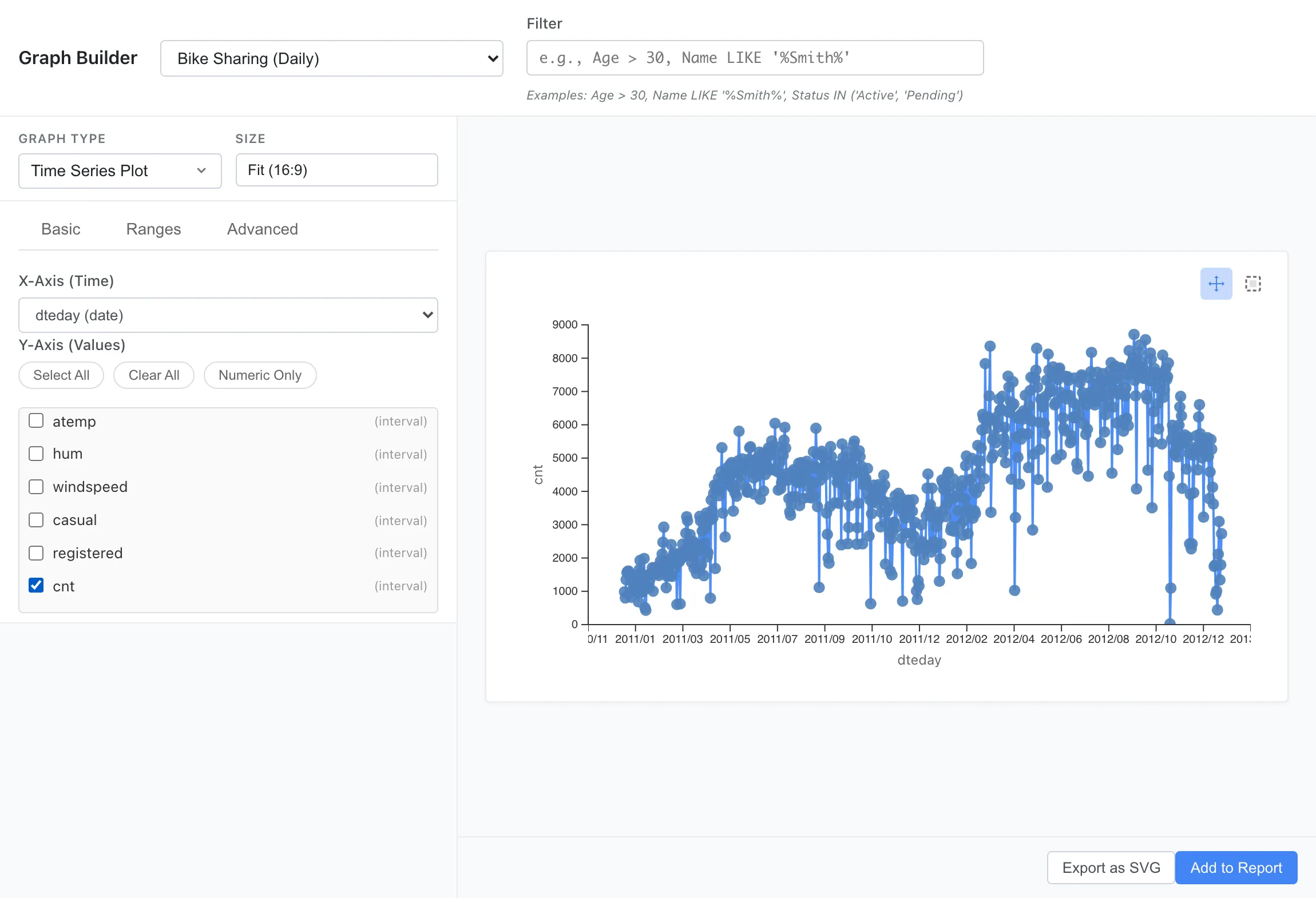
Displays data changes over time as a line chart. Identify trends, seasonality, and patterns. Display multiple time series with different line styles and compare across periods.
Use cases:
- Check daily sales trends
- Track monthly visitor changes
- Observe annual temperature variations
Settings:
Basic tab:
- X-Axis (Time): Column representing date or datetime
- Y-Axis (Values): Numeric columns to display (multiple selection supported)
Ranges tab:
- Custom Range Bands: Add bands to highlight specific periods or ranges
Advanced tab:
- Chart Title: Set the graph title
Other Graphs
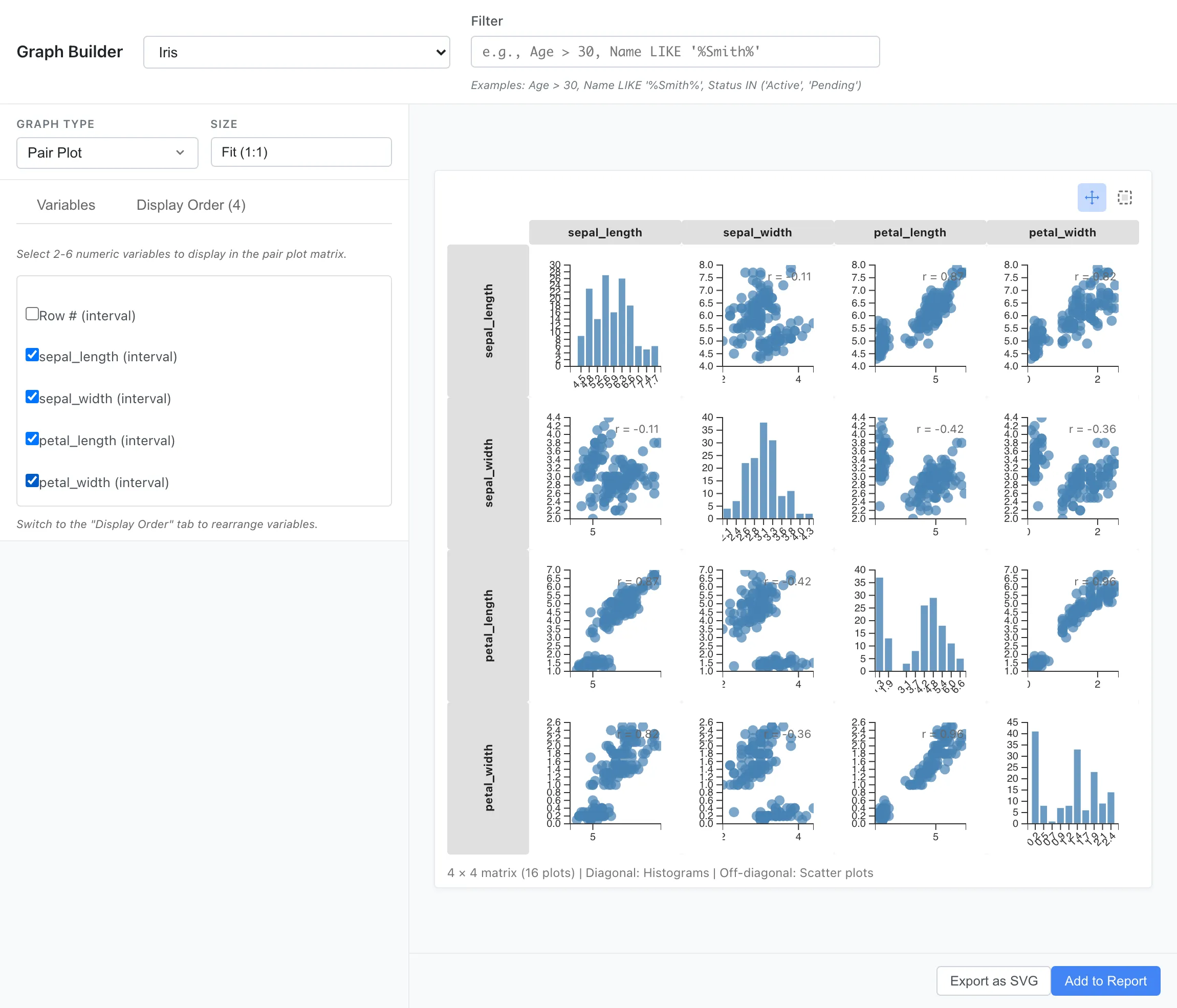
Pair Plot
Displays pairwise relationships between multiple numeric variables as a scatter plot matrix. The diagonal shows histograms, and off-diagonal cells show scatter plots with correlation coefficients.
Use cases:
- Check correlations between multiple measurements at once
- Understand the overall structure of a dataset
Settings:
- Variables: Select numeric columns via checkboxes (interval/ratio scale columns, minimum 2 variables). A warning is shown when selecting more than 6 variables due to performance and readability impact
- Display Order: Change the display order of selected variables
Datetime Histogram
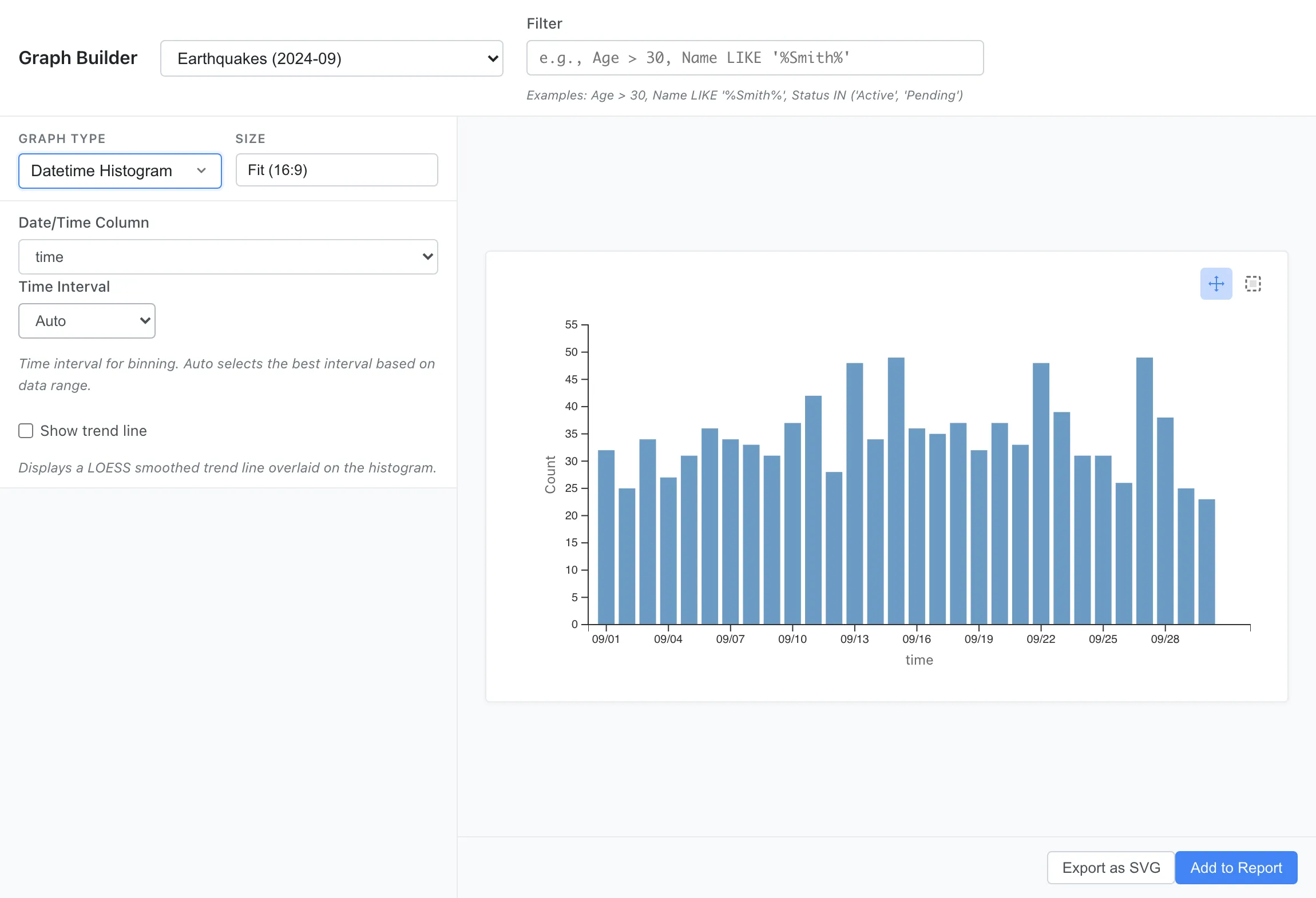
Visualizes the distribution of datetime data as a histogram on a time axis. Aggregates event frequency by time interval to identify temporal patterns.
Use cases:
- Check log event frequency by time period
- Visualize concentration of access times
- Analyze temporal distribution of orders and transactions
Settings:
- Date/Time Column: Column representing datetime or date
- Time Interval: Aggregation time interval (Auto, 1 minute to 1 year)
- Show trend line: Display a trend line using LOESS smoothing
Custom Graph
Creates flexible visualizations based on Grammar of Graphics principles. Build layered plots by combining geometric elements, statistical transformations, and aesthetic mappings.
See the Custom Graph Guide for details.
Graph Operations
Interactive Selection
All graphs support data point selection. Selection methods vary by graph type:
Rectangle Selection (Scatter Plot, Histogram, Datetime Histogram)
- Select mode: Drag mouse to select a range
- Pan mode: Drag graph to move the display range
Mode toggle buttons are displayed in the bottom-right corner of the graph.
Click Selection (Bar Chart, Time Series Plot, Pair Plot, Custom Graph)
- Click bars, points, or bins to select
- Ctrl/Cmd+click to add to selection or deselect
Selected rows are highlighted in other tabs such as Data Table, Statistics, and Selected Rows.
Saving Graphs
Graph settings created in Graph Builder are automatically saved to the project as tab state. Graph settings are preserved when you close and reopen the project.
Changing Settings
Graph settings (column selection, filters, display options, etc.) can be changed at any time. Graphs update in real-time when settings are changed.
Next steps
- Custom Graph - Flexible visualization with Grammar of Graphics
- Report - Compile graphs and tables into reports
See also
- Basic Statistics - Scatter plot matrices and correlation matrices for multivariate comparison
- Data Preparation and Import - Measurement scale settings that affect graph creation